Control rooms
Video walls for operations, network and security operations centres, dispatch centres and crisis rooms. VuWall systems over the IP network or with a central processor, with operator consoles designed to EN ISO 11064.

We design and build video walls for control rooms, dispatch and crisis rooms, as well as representative and retail spaces, from choosing the displays and processors to mounts, consoles and maintenance.
In a control room the video wall is the shared operational picture. It has to show every source, without interruption, for years. That is why we choose technology for its service life, not just its price.
Professional displays and processors designed for continuous operation.
Cameras, applications, SCADA and web content: IP and non-IP sources on one wall.
Prepared layouts for shifts, incidents and crisis situations, with clear user permissions.
Push-out mounts and spare parts, so a display is replaced without dismantling the wall.
Video walls for operations, network and security operations centres, dispatch centres and crisis rooms. VuWall systems over the IP network or with a central processor, with operator consoles designed to EN ISO 11064.
LCD and direct-view LED walls for retail spaces, lobbies, halls and façades, with eye-catching content, seamless and in any size.
Maintenance contracts with fast response, spare displays and parts in stock, and operator training.
Technologies: Samsung · VuWall · Datapath · Vogel’s · Chief / Legrand AV · Gesab
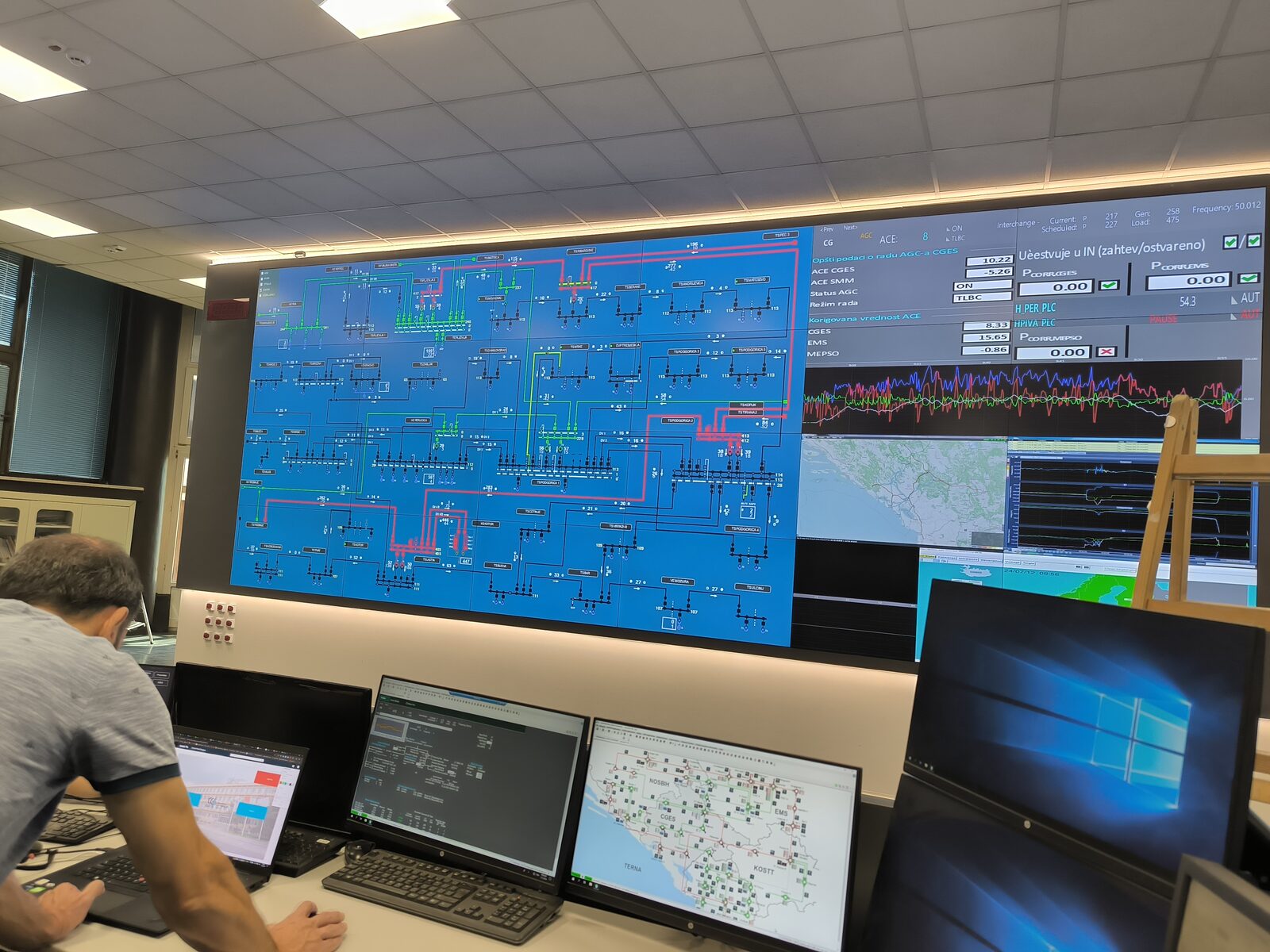
24 professional displays in continuous operation for monitoring Montenegro's power grid.
Read the case study → Belgrade Nikola Tesla Airport · VINCI AirportsDisplays for 12 video walls and more than 150 information screens, plus video walls with a VuWall system in the control centre.
Read the case study →An LCD wall is made up of several professional displays with very narrow bezels and is the most cost-effective option for medium and large walls in control rooms. A direct-view LED wall has no bezels, has uniform colour across the whole surface and can be any size, but it costs more.
A processor is a device or software that receives images from all sources (cameras, computers, applications) and arranges them on the wall. Through it, the operator chooses what is shown, where and at what size.
The bezel is the frame around a display. The narrower it is, the less visible the joins between displays on the wall. Control rooms use displays with bezels of only a few tenths of a millimetre.
It is a mount that lets an individual display be pulled forward out of the wall. Servicing and replacing a display then takes little time and does not require dismantling the whole wall.
Professional LCD displays are designed for tens of thousands of operating hours, and LED modules even longer. Because a video wall is used for years, the service life of the technology is one of the key selection criteria.
The image from a source is converted into a network signal and sent over the IP network to the displays. That way one system easily extends to more walls, rooms and sites, and sources do not have to be physically close to the wall.
It is the arrangement of the wall, consoles and workstations so that operators can see all the information clearly and work comfortably during long shifts. Control rooms follow the EN ISO 11064 standard.
Tell us about your sources, the space and how your operators work, and we will propose an architecture, technology and layout that make sense for your centre.
Book a call